

In This Blog
TL;DR
Cloud analytics uses cloud computing platforms to collect, analyze, and derive insights from data more efficiently than traditional on-premises solutions.
Key benefits include dynamic scalability to handle varying workloads, reduced infrastructure costs, faster deployment, and access to advanced AI capabilities.
Cloud analytics platforms like Microsoft Azure provide end-to-end solutions including data ingestion, storage, processing, and visualization tools.
Organizations across industries use cloud analytics for personalized customer experiences, supply chain optimization, predictive maintenance, and new business models.
Getting started requires selecting the right platform, migrating existing data and analytics assets, and aligning people, processes, and technology around data-driven decision making.
What Is Cloud Analytics?
Cloud analytics is the process of collecting, analyzing and deriving insights from data using cloud computing platforms and services. By leveraging the scalability, flexibility and power of the cloud, organizations can process and analyze massive amounts of data more efficiently than with traditional on-premises solutions.
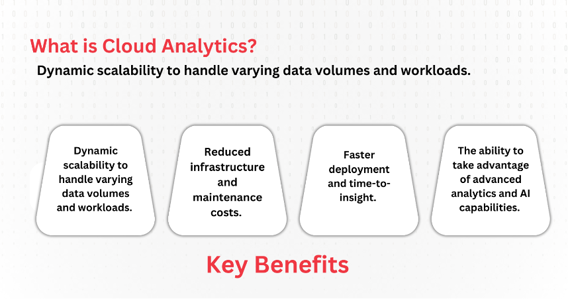
The key benefits of cloud analytics include:
Dynamic scalability to handle varying data volumes and workloads
Reduced infrastructure and maintenance costs
Faster deployment and time-to-insight
The ability to take advantage of advanced analytics and AI capabilities
You may also like: Maximizing the Value of Cloud Analytics and Big Data
Cloud analytics represents a fundamental shift from traditional business intelligence approaches. Instead of investing heavily in on-premises data warehouses and analytics infrastructure that's expensive to scale, organizations can leverage cloud platforms that provide elastic compute and storage resources, paying only for what they use. This democratizes advanced analytics, making powerful capabilities accessible to organizations of all sizes.
How Cloud Analytics Works
At a high level, a cloud analytics platform consists of several key components working together. The first step is collecting data from various sources and moving it to the cloud environment. This could include structured transactional data from ERP and CRM systems, unstructured data like emails, social media posts and documents, or real-time streaming data from mobile apps, IoT sensors and clickstream logs.
For example, Unilever, the global consumer packaged goods company, pipes petabytes of sales data, digital marketing interactions, and consumer sentiment data from dozens of source systems into a centralized data lake on Microsoft Azure. They then use Azure Data Factory and Azure Databricks to cleanse, transform and aggregate the raw data at scale.
The Azure Cloud Analytics Stack
Microsoft Azure offers an end-to-end cloud analytics solution. Companies can use Azure Data Factory to ingest and transform data from on-premises and cloud sources, then store it in Azure Data Lake Storage or Azure Synapse Analytics, a distributed data warehouse that can scale to petabytes of data. They can then use Azure Databricks, an Apache Spark-based analytics platform, to process and analyze the data using machine learning and advanced analytics.
The curated data is stored in cloud-based data warehouses like Microsoft Azure Synapse Analytics or data lakes built on object storage services like Azure Data Lake Storage, which can elastically scale to handle massive volumes.
Once the data is centralized in the cloud, the real analytics muscle kicks in. Cloud platforms provide managed services for data integration, data quality, data cataloging, and powerful analytics engines that can crunch through petabyte-scale datasets with ease.
AI and Machine Learning Integration
Microsoft Azure provides a rich set of AI and analytics capabilities. Azure Machine Learning enables data scientists and developers to build, train and deploy machine learning models at scale. Azure Cognitive Services offer pre-built AI models for common scenarios like sentiment analysis, image recognition and language translation. And Power BI, Microsoft's business intelligence platform, allows users to create interactive data visualizations and dashboards with natural language query.
This integration of analytics and AI capabilities within cloud platforms means organizations can move from descriptive analytics (what happened) to diagnostic analytics (why it happened) to predictive analytics (what will happen) to prescriptive analytics (what should we do) without managing complex infrastructure or integrating disparate tools.
Benefits of Cloud Analytics
Across industries, organizations are moving their analytics workloads to the cloud to take advantage of key benefits.
Near-Infinite Scalability
One of the biggest benefits is near-infinite scalability. Consider Qualpay, a provider of integrated omnichannel payment solutions for small and mid-sized businesses. By building their data analytics platform on Amazon Web Services, they can easily scale their storage and compute resources as their data volumes grow, without having to invest in and manage on-premises infrastructure. This allows them to focus on deriving valuable insights to better serve their customers, while keeping their IT costs under control.
Similarly, Anheuser-Busch InBev, the world's largest brewer, uses Microsoft Azure to collect and analyze over 500 billion sensor readings per year across its global manufacturing facilities. Azure's ability to elastically scale compute and storage resources enables AB InBev to combine real-time sensor data with transactional ERP data and apply machine learning to optimize production, ensure quality and reduce waste.
Cost Savings
In fact, cost savings is another major benefit of cloud analytics. With the cloud's consumption-based pricing model, companies only pay for the storage and compute resources they use, avoiding the big upfront capital expenses and ongoing maintenance of on-premises infrastructure.
The total cost of ownership comparison often favors cloud analytics significantly. Organizations eliminate hardware refresh cycles, reduce data center footprint, minimize IT staff dedicated to infrastructure management, and convert capital expenses to predictable operational expenses. For many organizations, cloud analytics reduces total analytics costs by 30-50% while dramatically improving capabilities.
Agility and Speed to Market
Just as important as cost savings is the agility and speed to market that cloud analytics enables. Instead of waiting weeks or months to provision hardware and configure software, a new cloud data warehouse or Spark cluster can be spun up in minutes. Analytics teams are freed from infrastructure management to focus on value-added analysis and insight delivery.
This agility transforms how organizations respond to business needs. A marketing team can launch a new customer segmentation analysis in days rather than months. A supply chain team can quickly test new optimization algorithms against historical data. An executive can get a custom dashboard built in a week rather than waiting for the next BI roadmap cycle.
You may also like: 7 Reasons Why You Should Use Azure For Software Development
Common Use Cases
This agility is powering cloud analytics use cases across industries and business functions.
Healthcare
In healthcare, Humana is using Microsoft Azure to integrate data across its member touchpoints, clinical interactions, and provider network. By building a unified data platform on Azure, they can apply advanced analytics and machine learning to personalize member recommendations, improve healthcare outcomes, and reduce costs.
Retail
In retail, Walgreens Boots Alliance, a global pharmacy and healthcare company, built a cloud-native data platform on Azure to drive customer-centric marketing, optimize supply chain and enable new healthcare services. They leverage Azure Synapse Analytics to process over 200 million transactions per week, powering personalized omnichannel experiences.
Manufacturing
And in manufacturing, Rockwell Automation built a scalable IoT platform on Azure to help its customers monitor and optimize industrial equipment and processes. Streaming data from millions of connected devices is ingested using Azure IoT Hub and processed in real-time with Azure Stream Analytics, enabling predictive maintenance and remote asset management.
Additional Success Stories
Other Microsoft customers are also achieving transformative results with cloud analytics on Azure. Majid Al Futtaim, a leading retail and entertainment conglomerate in the Middle East, Africa and Asia, used Azure Synapse Analytics and Power BI to unify data across its business lines and build an enterprise-wide analytics platform. This enabled them to optimize inventory, personalize customer engagement, and launch new data-driven businesses.
H&R Block, a leading tax preparation company, used Azure and Power BI to reimagine the tax filing experience, combining data from 20 million tax returns with third-party data sources to provide personalized insights to customers. This demonstrates how cloud analytics can transform traditional business models and create new value propositions.
Getting Started with Cloud Analytics
If you're not using cloud analytics today, getting started is easier than you might think.
Selecting the Right Platform
The first step is selecting the right cloud analytics platform for your needs. Leading cloud providers like Microsoft Azure, AWS, and Google Cloud, along with specialized platforms like Snowflake and Databricks, all have compelling offerings, but they each have their strengths and tradeoffs.
Key considerations include:
Performance at scale (concurrency, query speed)
Breadth of analytics and AI/ML services
Quality of migration and ETL tools
Ecosystem of technology partners
Security and compliance certifications
Total cost of ownership
Many organizations pursue a multi-cloud strategy to avoid lock-in and tap the best capabilities of each platform, though this approach adds complexity in governance, skill development, and cost management.
Migrating Data and Analytics Assets
The next step is migrating existing data and analytics assets to the cloud. For "lift and shift" migrations of large datasets, cloud providers offer secure offline transfer appliances like AWS Snowmobile, Azure Data Box and Google Transfer Appliance that can move petabytes of data. Online services like AWS Database Migration Service, Azure Data Factory and Snowflake SnowMirror enable continuous replication of on-premises data to the cloud.
But successful cloud migrations require more than just copying data. Analytics processes and workloads like data integration pipelines, BI data models and dashboards also need to be rebuilt for the cloud. The best approach is to start with a small, high-impact use case to build momentum and validate the target architecture, then iterate and scale over time.
Building Organizational Capabilities
Ultimately, building a successful cloud analytics capability requires aligning people, processes and technology around data-driven decision making. Companies need to invest in data literacy and self-service analytics tools to empower business users. They need DataOps practices to ensure data quality and governance at scale. And they need an agile, business-focused delivery model to drive adoption and measure ROI.
This organizational transformation is often harder than the technical migration. It requires executive sponsorship, change management, training programs, and patience. But organizations that successfully build data-driven cultures around cloud analytics capabilities gain significant competitive advantages.
How Emergent Software Can Help
We specialize in helping organizations implement and optimize cloud analytics solutions on Microsoft Azure. Our team has deep expertise in Azure Synapse Analytics, Azure Data Factory, Azure Databricks, and Power BI, along with proven methodologies for cloud analytics adoption. Whether you're migrating from on-premises data warehouses, building new analytics capabilities, or optimizing existing Azure deployments, we provide the strategic guidance and technical implementation to ensure successful outcomes. We help organizations assess their analytics maturity, design target architectures, execute migrations, and build the organizational capabilities needed to become truly data-driven. Our focus on the Microsoft Azure ecosystem positions us to help you leverage the full power of Azure's integrated analytics and AI services.
If this sounds familiar, we can help.
Final Thoughts
Cloud analytics is leveraging the power of data to drive innovation and competitive advantage like never before. By providing near-infinite scale, elastic computing and advanced analytics services, the cloud is making it possible for organizations to extract insight from the massive volumes of data they generate every day.
The transformation that cloud analytics enables goes beyond just technical capabilities. It fundamentally changes how organizations make decisions, respond to market changes, and create value for customers. Instead of relying on monthly reports and static dashboards, business leaders can access real-time insights and drill into details on demand. Instead of waiting for IT to build new analytics capabilities, business analysts can self-serve using intuitive tools. Instead of making decisions based on intuition or limited data, organizations can leverage comprehensive data and predictive models.
The most successful cloud analytics implementations share common characteristics. They start with clear business objectives rather than technology for technology's sake. They prioritize data quality and governance from the beginning rather than treating them as afterthoughts. They invest in organizational change management and training, not just technology. They adopt agile delivery approaches that deliver value incrementally rather than waiting for big-bang implementations. And they measure success based on business outcomes, not just technical metrics.
Common pitfalls to avoid include lifting and shifting on-premises architectures to the cloud without redesigning for cloud-native patterns, underestimating the organizational change required to become data-driven, neglecting data governance and security in the rush to deliver capabilities, trying to do too much too fast rather than starting small and scaling, and choosing platforms based on features rather than fit with organizational needs and capabilities.
The cloud analytics landscape continues to evolve rapidly. Serverless analytics services are simplifying operations further. Real-time analytics and streaming capabilities are becoming mainstream. AI and machine learning are being embedded throughout analytics workflows. Data mesh architectures are changing how organizations govern and share data. Low-code and no-code tools are democratizing analytics creation. Organizations that stay current with these developments while maintaining focus on business value will be best positioned for success.
And with the right strategy and execution, any company can harness this potential and become a truly data-driven enterprise. It starts with identifying high-impact use cases, picking the right technology platform and migration approach, and focusing on change management to drive adoption. With those elements in place, the opportunities are limitless — from optimizing operations and personalizing customer experiences to launching entirely new business models and revenue streams.
The competitive advantage of cloud analytics isn't just about having better technology. It's about making better decisions faster, understanding customers more deeply, operating more efficiently, and innovating more rapidly. In an increasingly digital economy, these capabilities separate leaders from laggards.
If you're ready to transform your business with cloud analytics, Emergent Software is here to help. Reach out, we'd love to learn more about your goals.
Frequently Asked Questions
What does a cloud analyst do?
A cloud analyst evaluates, implements, and optimizes cloud-based solutions to enhance organizational efficiency and performance. They specialize in leveraging cloud technologies to meet business objectives and improve scalability. More specifically, cloud analysts assess data requirements and analytics needs, design cloud analytics architectures using platforms like Azure, AWS, or Google Cloud, implement data pipelines and integration workflows, build data models and analytics solutions, optimize performance and costs, ensure security and compliance, and provide training and support to analytics users. Cloud analysts bridge the gap between business needs and technical implementation, translating business questions into analytics solutions and helping organizations extract maximum value from their data. They typically have skills spanning data engineering, business intelligence, cloud platforms, and business analysis. As organizations increasingly move analytics to the cloud, demand for cloud analysts with these hybrid skills continues to grow.
What is the difference between cloud analytics and cloud computing?
Cloud analytics and cloud computing are related but distinct concepts. Cloud computing is the broad category of delivering various computing services over the internet, including storage, databases, networking, software, and analytics. It's the infrastructure and platform layer that makes cloud-based services possible. Cloud analytics is a specific application of cloud computing focused on analyzing and interpreting data to derive insights. It leverages cloud computing infrastructure but adds analytics-specific capabilities like data warehouses, analytics engines, visualization tools, and machine learning services. Think of cloud computing as the foundation and cloud analytics as one of many things you can build on that foundation. Other cloud computing applications include SaaS applications, development platforms, IoT services, and more. Cloud analytics specifically uses cloud computing's scalability and flexibility to handle data processing and analysis workloads. So cloud computing is the "what" (the technology infrastructure), while cloud analytics is a "how" (a specific use case of that infrastructure for data analysis).
Which benefits are achieved using cloud analytics?
Cloud analytics provides numerous benefits that drive its widespread adoption. Scalability allows organizations to handle large datasets and varying workloads without infrastructure constraints, scaling compute and storage up or down based on demand. Cost-efficiency eliminates the need for expensive on-premises infrastructure, converting capital expenses to predictable operational expenses and paying only for resources consumed. Real-time insights enable informed decision-making with up-to-date data rather than relying on stale reports. Improved collaboration allows teams to share data access and insights across the organization easily. Faster time to value means new analytics capabilities can be deployed in days or weeks rather than months. Advanced capabilities provide access to sophisticated AI and machine learning services that would be difficult to build and maintain on-premises. Flexibility supports integration with various data sources and analytics tools without being locked into specific vendors. Reliability ensures high availability and disaster recovery without managing complex infrastructure. These benefits compound — the cost savings from cloud infrastructure enable investment in more advanced analytics, which drives better insights, which improve business outcomes, which justify further investment in analytics capabilities.
Which features are included in a cloud analytics tool?
Cloud analytics tools typically include a comprehensive set of features spanning the analytics lifecycle. Data visualization capabilities present insights visually through charts, graphs, dashboards, and reports, often with drag-and-drop interfaces that don't require coding. Predictive modeling features enable forecasting trends and outcomes using machine learning algorithms. Real-time data processing allows immediate analysis of streaming data as it arrives. Integration capabilities connect with various data sources including databases, applications, APIs, and files. Data preparation and transformation tools cleanse, enrich, and reshape data for analysis. Collaboration features enable sharing insights, dashboards, and reports across teams. Self-service analytics empower business users to explore data and create visualizations without IT assistance. Natural language query allows users to ask questions in plain English rather than writing SQL. Embedded analytics enable insights to be incorporated into applications and workflows. Mobile access provides analytics capabilities on smartphones and tablets. Security and governance features control data access, track usage, and ensure compliance. Automated insights use AI to surface interesting patterns and anomalies without manual analysis. The specific features and their sophistication vary by tool and vendor, but comprehensive cloud analytics platforms like Azure Synapse Analytics and Power BI provide most or all of these capabilities.
What is an example of cloud analytics?
Google Analytics is a widely recognized example of cloud analytics, offering web traffic analysis, user behavior insights, and performance metrics for websites and mobile apps using data stored in the cloud. Users integrate a tracking code into their web properties, and Google Analytics collects interaction data, processes it in Google's cloud infrastructure, and provides dashboards and reports for understanding user behavior, traffic sources, conversion funnels, and content performance. This exemplifies cloud analytics because all data collection, storage, processing, and analysis happens in the cloud — users access insights through web browsers without managing any infrastructure. Other common examples include Salesforce Analytics (Einstein Analytics) for CRM data analysis, Power BI for enterprise business intelligence, Snowflake for cloud data warehousing and analytics, and Databricks for big data and machine learning. In the Microsoft ecosystem specifically, a typical cloud analytics implementation might use Azure Data Factory to ingest data from multiple sources, Azure Data Lake Storage to store raw data, Azure Synapse Analytics to process and analyze data at scale, Azure Machine Learning to build predictive models, and Power BI to visualize insights and share them across the organization. This integrated approach represents the full power of cloud analytics — from data collection through insight delivery.
How do I measure ROI from cloud analytics?
Measuring ROI from cloud analytics requires considering both hard and soft benefits against implementation and ongoing costs. On the cost side, include cloud platform fees for compute, storage, and services, implementation costs for migration and development, training and change management expenses, and ongoing support and maintenance. On the benefit side, quantify reduced infrastructure costs from eliminating on-premises hardware, time savings from faster insights and self-service capabilities, improved business outcomes from better decisions, revenue growth from new capabilities like personalization, operational efficiencies from process optimization, and risk reduction from better visibility and predictive capabilities. The challenge is that many benefits are indirect. If cloud analytics enables better inventory management that reduces stockouts by 10%, how do you value that? If executives make better strategic decisions because they have real-time data, what's that worth? Practical approaches include starting with easily quantifiable benefits like infrastructure cost reduction and time savings to establish baseline ROI, tracking business metrics before and after analytics implementation to measure impact, conducting case studies of specific decisions influenced by analytics and their outcomes, and surveying users about time saved and value delivered. Most organizations find that cloud analytics ROI is positive within 12-24 months when infrastructure savings are considered, and becomes increasingly positive as business impact accumulates over time. The key is establishing metrics upfront and tracking them consistently rather than trying to retroactively justify investments.
Author



Let’s Start Building Together
Whether you're modernizing legacy apps, strengthening your cloud security, or planning your next big initiative, Emergent Software is here to help.