

In This Blog
TL;DR
Container orchestration automates the deployment, scaling, and management of containerized applications across distributed environments.
Key functions include automated deployment and scaling, load balancing, health monitoring with self-healing, and automated updates and rollbacks.
Benefits include seamless scalability, improved resilience through automated failover, efficient resource utilization, and flexibility across hybrid and multi-cloud environments.
Kubernetes has emerged as the industry-standard container orchestration platform, with managed services like Azure Kubernetes Service simplifying adoption.
Container orchestration is essential for organizations running containerized applications at scale, transforming container management from manual to automated.
What Is Container Orchestration?
The introduction of containerization has been a game-changer in software development over the past few years. By allowing developers to package applications and their dependencies into lightweight, portable containers, this technology has significantly streamlined the development, deployment, and management of software.
As companies continue adopting containerization to improve agility and scalability, the need to manage these containers efficiently becomes critical. This is where container orchestration comes into play.
Container orchestration is the automated process of managing the lifecycle of containers, particularly in large, distributed environments. This includes deploying containers across a cluster of machines, scaling them up or down based on demand, managing their communication and networking, and monitoring their health.
Essentially, container orchestration handles all the heavy lifting associated with running containers in production, allowing developers to focus on building applications rather than managing infrastructure.
The Challenge of Managing Containers at Scale
Managing containers at scale presents several challenges. Without orchestration, teams would need to manually deploy, manage, and scale individual containers, which is time-consuming and prone to error. Consider an e-commerce platform running hundreds of microservices, each packaged as a container. During Black Friday, traffic might spike 10x, requiring rapid scaling. Manually starting containers, configuring networking, and load balancing across this many instances would be impossible.
In addition, as the number of containers grows, so does the complexity of managing them. Questions arise: Which containers are running on which hosts? How do containers discover and communicate with each other? What happens when a container crashes? How do you deploy updates without downtime?
Container orchestration addresses these challenges by providing a framework for automating the deployment, scaling, and management of containers across multiple hosts. This ensures consistency, reliability, and efficiency in containerized environments, regardless of their size or complexity.
Key Functions of Container Orchestration
Container orchestrators serve many important functions that transform how organizations deploy and manage applications.
Automated Deployment and Scaling
One of the primary functions of container orchestration is automated deployment and scaling. Orchestration tools can automatically deploy containers based on predefined rules and scale them up or down depending on traffic or resource usage. This ensures that applications can handle varying loads without requiring manual intervention, improving both performance and resource utilization.
For example, you might define a rule that says "always run at least 3 instances of this service, but scale up to 20 instances if CPU usage exceeds 70%." The orchestrator monitors metrics and automatically adds or removes containers to maintain these parameters.
Load Balancing and Traffic Management
Container orchestration also includes load balancing and traffic management, which are crucial for maintaining the availability, security, and performance of applications. Container orchestration platforms distribute incoming traffic evenly across multiple containers, ensuring that no single container becomes a bottleneck.
This is especially important in microservices architectures, where different services need to communicate efficiently. The orchestrator maintains service discovery so containers can find and communicate with each other, even as instances are added, removed, or moved across the cluster.
Health Monitoring and Self-Healing
Another critical function of container orchestration is health monitoring and self-healing. Orchestration tools continuously monitor the health of running containers and automatically replace those that fail or become unhealthy. Self-healing ensures that applications remain resilient and available, even in the face of failures.
If a container crashes, freezes, or fails its health check, the orchestrator automatically stops it and starts a replacement. If an entire node fails, the orchestrator reschedules all containers from that node onto healthy nodes. This happens automatically, without human intervention.
Automated Updates and Rollbacks
Updating containerized applications is often a complex process that can introduce downtime or errors if not handled properly. Container orchestration platforms provide automated updates and rollbacks, enabling developers and administrators to deploy new versions of their applications with confidence.
The orchestrator can perform rolling updates, gradually replacing old container versions with new ones while maintaining application availability. If an update causes issues, the tool can automatically roll back to the previous version to minimize the impact on users. You can define strategies like blue-green deployments or canary releases to test updates with a small percentage of traffic before full rollout.
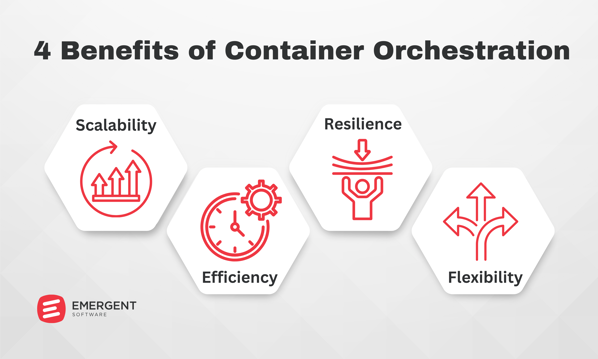
4 Benefits of Container Orchestration
Container orchestration delivers significant benefits that justify its adoption in modern software environments.
Scalability
One of the most significant benefits of container orchestration is scalability. Orchestration tools allow companies to scale their applications seamlessly, adding or removing containers based on demand. Better scalability means applications can handle high traffic volumes without downtime or performance degradation, allowing businesses to grow and adapt to changing needs.
Scalability works in both directions. During peak periods, the orchestrator adds capacity automatically. During quiet periods, it scales back down, reducing costs. This elasticity is one of the core value propositions of cloud-native architecture.
Resilience
Resilience is another key benefit of container orchestration. Through self-healing and automated failovers, orchestration tools ensure that applications remain up and running even when individual containers fail. This minimizes downtime and enhances the overall reliability of the application, which is critical for maintaining user satisfaction.
The orchestrator's automated recovery mechanisms mean that transient failures — the kind that happen regularly in distributed systems — are handled automatically without impacting users. Applications become more resilient not because failures stop happening, but because the system recovers from them automatically.
Efficiency
Container orchestration optimizes resource utilization by dynamically scheduling containers based on available resources. This means that containers are efficiently distributed across the cluster, avoiding resource contention and ensuring that no resources go to waste.
As a result, companies can reduce their infrastructure costs while maintaining high performance. The orchestrator understands the resource requirements of each container and the available capacity on each node, and it makes intelligent decisions about where to place workloads. This bin-packing optimization can significantly improve cluster utilization compared to manual placement.
Flexibility
Finally, container orchestration offers unparalleled flexibility, particularly in supporting hybrid and multi-cloud environments. Orchestration tools like Kubernetes allow companies to deploy and manage containers across different cloud providers or on-premises data centers.
This flexibility is crucial for businesses that need to adapt quickly to changing requirements or leverage the unique features of different cloud platforms. You can run the same orchestrated application on Azure today and AWS tomorrow with minimal changes. You can distribute workloads across multiple clouds for redundancy or regulatory compliance. The abstraction layer provided by orchestration makes your applications portable across infrastructure.
Popular Container Orchestration Tools
While several container orchestration tools exist, Kubernetes has emerged as the industry standard.
Kubernetes
Kubernetes is the most widely adopted container orchestration platform. Originally developed by Google and now maintained by the Cloud Native Computing Foundation, Kubernetes provides a comprehensive set of features for deploying, scaling, and managing containerized applications.
Kubernetes has become the de facto standard due to its robust feature set, active community, and broad ecosystem of tools and integrations. Most major cloud providers offer managed Kubernetes services that simplify deployment and operations.
Azure Kubernetes Service (AKS)
Azure Kubernetes Service (AKS) is Microsoft's managed Kubernetes offering. AKS simplifies Kubernetes deployment and operations by handling tasks like cluster provisioning, upgrades, and monitoring. It integrates seamlessly with other Azure services like Azure Active Directory, Azure Monitor, and Azure Container Registry.
AKS eliminates much of the operational complexity of running Kubernetes, allowing organizations to focus on deploying applications rather than managing infrastructure. Microsoft handles the Kubernetes control plane, while you manage the worker nodes and applications.
Other Orchestration Tools
While Kubernetes dominates the market, other orchestration tools exist. Docker Swarm, built into Docker, provides simpler orchestration for smaller-scale deployments. Apache Mesos with Marathon offers orchestration capabilities, particularly for organizations with diverse workload types beyond just containers.
However, Kubernetes has won the orchestration war in terms of adoption, ecosystem, and investment from major technology vendors. For most organizations starting with container orchestration today, Kubernetes — particularly through a managed service like AKS — is the practical choice.
How Emergent Software Can Help
We specialize in helping organizations implement and optimize container orchestration using Azure Kubernetes Service. Our team has extensive experience designing Kubernetes architectures, migrating applications to containers and Kubernetes, implementing CI/CD pipelines for containerized applications, and optimizing AKS clusters for performance and cost. Whether you're just starting with containers, migrating existing applications to Kubernetes, or looking to optimize your current AKS environment, we provide the expertise and guidance to ensure successful outcomes. We help organizations adopt containerization and orchestration in ways that deliver real business value, not just technical novelty. From architecture design through implementation, training, and ongoing optimization, we partner with you to build the capabilities needed to succeed with containers and Kubernetes.
If this sounds familiar, we can help.
Final Thoughts
Container orchestration is a vital component of modern software development, particularly in environments where containerization is used at scale. By automating the deployment, scaling, management, and monitoring of containers, companies can build and maintain scalable, resilient, and efficient applications.
The shift from manually managing containers to using orchestration represents a fundamental change in how we operate applications. Just as we moved from managing individual servers to managing virtual machines, and from VMs to containers, orchestration represents the next level of abstraction. You're no longer managing individual containers, you're declaring desired state and letting the orchestrator maintain it.
This declarative approach has profound implications. Instead of scripting "start this container, then configure networking, then start that container," you declare "I want 3 instances of this service running with these characteristics" and the orchestrator makes it happen. When a container fails, you don't need to detect it and restart it manually, the orchestrator maintains your desired state automatically.
The benefits of this approach are compelling: applications become more scalable, more resilient, more efficient, and more portable. Scalability happens automatically based on demand rather than requiring manual intervention. Resilience improves because the system recovers from failures automatically. Efficiency increases through intelligent resource scheduling. Portability expands because applications can run anywhere Kubernetes runs.
However, container orchestration also introduces complexity. Kubernetes in particular has a steep learning curve. Concepts like pods, services, deployments, ingress controllers, and persistent volumes require new knowledge. Operating Kubernetes clusters requires new skills and tools. The ecosystem moves quickly, with frequent updates and evolving best practices.
This is where managed services like Azure Kubernetes Service provide value. By handling the Kubernetes control plane, AKS eliminates much of the operational burden. You get the benefits of Kubernetes without managing the underlying infrastructure. Microsoft handles upgrades, monitors the control plane, and ensures availability while you focus on deploying and managing your applications.
For organizations considering container orchestration, the question is often not whether to adopt it but when and how. If you're running containerized applications at any significant scale, orchestration quickly becomes essential. Manual management doesn't scale beyond a handful of containers. But adoption requires investment in learning, tooling, and organizational change.
The successful path typically involves starting small, gaining experience, and expanding gradually. Begin with non-critical applications to learn Kubernetes concepts and operations. Establish CI/CD pipelines for containerized deployments. Build monitoring and logging infrastructure. Develop expertise within your team. Then progressively migrate more applications as confidence and capabilities grow.
As containerization continues to grow in importance, so will the role of container orchestration. Companies that invest in these tools will be better equipped to manage the complexities of modern software development and thrive in an increasingly competitive landscape. It doesn't matter if you're managing a small set of containers or overseeing a distributed environment, understanding and leveraging container orchestration is a core IT practice that forward-thinking organizations must master.
The future of application deployment and management is containerized and orchestrated. Organizations that develop these capabilities now position themselves for success in a cloud-native world.
If you're ready to improve your container management with Azure Kubernetes Service, Emergent Software is here to help. Reach out,we'd love to learn more about your goals.
Frequently Asked Questions
What is container orchestration in simple terms?
Container orchestration is an automated system that manages many containers working together, ensuring they run smoothly even when things get complicated. Think of it like an air traffic controller for containers. Just as air traffic controllers coordinate dozens of planes taking off, landing, and navigating through airspace, container orchestration coordinates hundreds or thousands of containers, ensuring they're deployed correctly, scaled appropriately, communicating effectively, and recovering from failures automatically. Without orchestration, managing containers manually would be like trying to coordinate air traffic with phone calls and spreadsheets — theoretically possible for a few planes, but impossible at scale. Orchestration provides the automation, coordination, and intelligence needed to run containerized applications reliably in production. It handles the routine operational tasks like deploying containers, monitoring their health, replacing failed instances, scaling based on demand, and managing networking so containers can find and communicate with each other. This automation allows developers and operators to focus on building features rather than managing infrastructure.
Is Kubernetes a container orchestration tool?
Yes, Kubernetes is the most popular and widely adopted container orchestration tool. Originally developed by Google based on their internal container orchestration systems, Kubernetes was open-sourced in 2014 and donated to the Cloud Native Computing Foundation. It has since become the industry standard for container orchestration, with broad adoption across organizations of all sizes and extensive support from major technology vendors. Kubernetes provides comprehensive orchestration capabilities including automated deployment, scaling, service discovery, load balancing, rolling updates, health monitoring, self-healing, and much more. Its declarative configuration model allows you to specify the desired state of your application, and Kubernetes continuously works to maintain that state. The platform supports running containers across clusters of machines, whether on-premises, in the cloud, or in hybrid environments. While other orchestration tools exist, Kubernetes has emerged as the clear market leader with the largest ecosystem, most active community, and broadest industry support.
What is the best container orchestration tool?
Kubernetes is widely considered the best container orchestration tool for most use cases due to its widespread adoption, scalability, feature richness, and robust ecosystem. This doesn't mean it's the only option or the right choice for every scenario, but its market dominance and comprehensive capabilities make it the default recommendation. Kubernetes excels at managing containerized applications at any scale, from small deployments to massive distributed systems running thousands of containers. Its declarative configuration model, powerful scheduling capabilities, extensive networking features, and self-healing mechanisms provide a solid foundation for production workloads. The Kubernetes ecosystem includes thousands of tools and integrations for monitoring, security, storage, networking, and more. Every major cloud provider offers managed Kubernetes services, and a large community provides support, documentation, and shared knowledge. That said, for very simple use cases or small-scale deployments, lighter-weight alternatives like Docker Swarm might be easier to adopt. But for organizations running containerized applications at scale or planning to grow, Kubernetes has become the pragmatic choice.
What is the difference between Docker and Kubernetes?
Docker and Kubernetes serve different but complementary purposes in the containerization ecosystem. Docker is a platform for creating and running containers — it provides the tools to package applications with their dependencies into container images and run those containers on individual machines. Kubernetes is a platform for orchestrating and managing containers at scale across clusters of machines. Think of Docker as providing the containers themselves, while Kubernetes provides the system for managing those containers in production. In a typical workflow, developers use Docker to build container images locally, test them, and push them to a container registry. Then Kubernetes pulls those images and deploys them across a cluster, managing their lifecycle, scaling, networking, and health. Docker focuses on the container runtime and tooling for individual machines, while Kubernetes focuses on cluster-level orchestration across many machines. You can use Docker without Kubernetes for development or simple deployments, but you typically need both for production containerized applications at scale. Kubernetes actually doesn't require Docker specifically — it can work with other container runtimes — but Docker remains the most common way to build container images that Kubernetes then orchestrates.
How does container orchestration handle persistent data?
Container orchestration handles persistent data through abstractions that allow stateful applications to run in containers while maintaining data across container restarts, moves, and failures. This is one of the more complex aspects of orchestration because containers are designed to be ephemeral and stateless, but many applications need to persist data. Kubernetes addresses this through Persistent Volumes (PVs) and Persistent Volume Claims (PVCs). A Persistent Volume represents a piece of storage in the cluster, whether it's a disk in the cloud, network-attached storage, or local storage on a node. Applications request storage through Persistent Volume Claims, which specify requirements like size and access mode. Kubernetes matches claims to available volumes and mounts the storage into containers. When a container fails and is recreated, or when it's moved to a different node, the orchestrator reattaches the same persistent volume so data persists. For databases and other stateful applications, Kubernetes provides StatefulSets, which maintain stable identities for pods and guarantee ordering and uniqueness. This allows databases to maintain their data and configuration across restarts and rescheduling. Cloud providers' managed Kubernetes services typically integrate with cloud storage offerings, making it easier to provision and manage persistent storage for containerized applications.
When should you use container orchestration?
You should use container orchestration when you're running containerized applications at any significant scale or when operational requirements demand automation and resilience. Specific scenarios that benefit from orchestration include running more than a handful of containers where manual management becomes impractical, needing automated scaling based on demand to handle traffic variability, requiring high availability with automatic failover when failures occur, deploying microservices architectures with many independent services that need to communicate, managing multi-environment deployments across development, staging, and production, and operating in production where downtime is costly and manual operations are risky. If you're running 3-5 containers for a side project, orchestration might be overkill. But if you're running production applications that serve real users, need to scale, and must stay available, orchestration quickly becomes essential. The automation, resilience, and operational efficiency that orchestration provides justify the learning curve and complexity for production workloads. That said, container orchestration isn't free — it introduces complexity and requires new skills. Don't adopt Kubernetes just because everyone else is. Adopt it when the problems it solves — managing containers at scale, automating operations, ensuring availability — are problems you actually have.
Author



Let’s Start Building Together
Whether you're modernizing legacy apps, strengthening your cloud security, or planning your next big initiative, Emergent Software is here to help.