

In This Blog
TL;DR
The Microsoft Cloud Adoption Framework (CAF) provides guidance, tools, and best practices for organizations adopting Azure cloud technologies.
CAF helps businesses build structured cloud strategies instead of approaching cloud migration as only a technical infrastructure project.
The framework includes six core stages: Strategy, Plan, Ready, Adopt, Govern, and Manage.
CAF helps organizations improve security, governance, scalability, operational readiness, and cloud cost management.
Working with an experienced Azure consulting partner can help organizations apply CAF more effectively and avoid common cloud adoption mistakes.
Introduction
Deciding to invest in cloud adoption is usually the easy part. Most organizations today understand the importance of cloud platforms like Microsoft Azure.
The harder part comes afterward.
Questions quickly start piling up:
How much should you budget for cloud resources?
Which systems should move to the cloud first?
What workloads should stay on-premises?
How should your cloud environment be secured?
Who is responsible for governance and operations?
How do you avoid creating an overly fragmented cloud environment?
To help organizations navigate those complexities, Microsoft created the Cloud Adoption Framework (CAF) for Azure.
CAF provides guidance, best practices, documentation, tools, and methodologies designed to help organizations create and execute successful cloud adoption strategies within Azure.
While the framework is extremely valuable, it can also feel overwhelming at first because of the sheer amount of information involved.
This article breaks down the major sections of the Microsoft Cloud Adoption Framework and explains how organizations can use it to guide cloud transformation initiatives.
What Is the Microsoft Cloud Adoption Framework for Azure?
The Microsoft Cloud Adoption Framework for Azure is a collection of guidance, documentation, tools, templates, and best practices designed to help organizations adopt cloud technologies strategically.
CAF is intended to support organizations through the full lifecycle of cloud adoption, including:
Cloud strategy development
Planning and readiness
Migration and modernization
Governance and compliance
Operations and management
The framework is useful for:
IT leaders
Executives
Cloud architects
Operations teams
Security teams
Business stakeholders
CAF is not only for organizations beginning their cloud journey. Businesses at nearly any stage of cloud maturity can use the framework to improve governance, architecture, operations, and modernization strategies.
That said, the framework becomes much more valuable when paired with real-world implementation experience. Many organizations work with an experienced Azure cloud consulting partner to help apply CAF principles effectively within their own environment.
Where Can I Find the Microsoft CAF?
Microsoft provides extensive public documentation and resources for the Cloud Adoption Framework.
You can access the framework directly through:
Microsoft’s Cloud Adoption Framework page
From there, organizations can access:
Strategy documents
Templates
Assessments
Architecture guidance
Landing zone documentation
Governance recommendations
Migration tools
Operational best practices
Microsoft continuously updates CAF as Azure services and cloud best practices evolve.
Why Is the Cloud Adoption Framework Important?
One of the biggest mistakes organizations make is treating cloud adoption as only a technical migration project.
Simply moving workloads into Azure without a broader strategy often creates:
Inconsistent architecture
Security gaps
Poor governance
Operational inefficiencies
Unexpected costs
Scalability limitations
The Cloud Adoption Framework helps organizations avoid those problems by encouraging a more structured and strategic approach.
Using CAF helps organizations:
Understand their current environment
Align stakeholders around cloud goals
Follow proven best practices
Reduce implementation risk
Improve security and governance
Create scalable operational models
Modernize infrastructure more effectively
Instead of reinventing cloud adoption processes from scratch, organizations can leverage Microsoft’s accumulated experience and guidance from thousands of Azure implementations.
What Are the Stages of the Microsoft Cloud Adoption Framework?
The Microsoft Cloud Adoption Framework is divided into six major sections:
Strategy
Plan
Ready
Adopt
Govern
Manage
The first four phases generally follow a sequential progression, while the Govern and Manage stages continue throughout the entire cloud lifecycle.
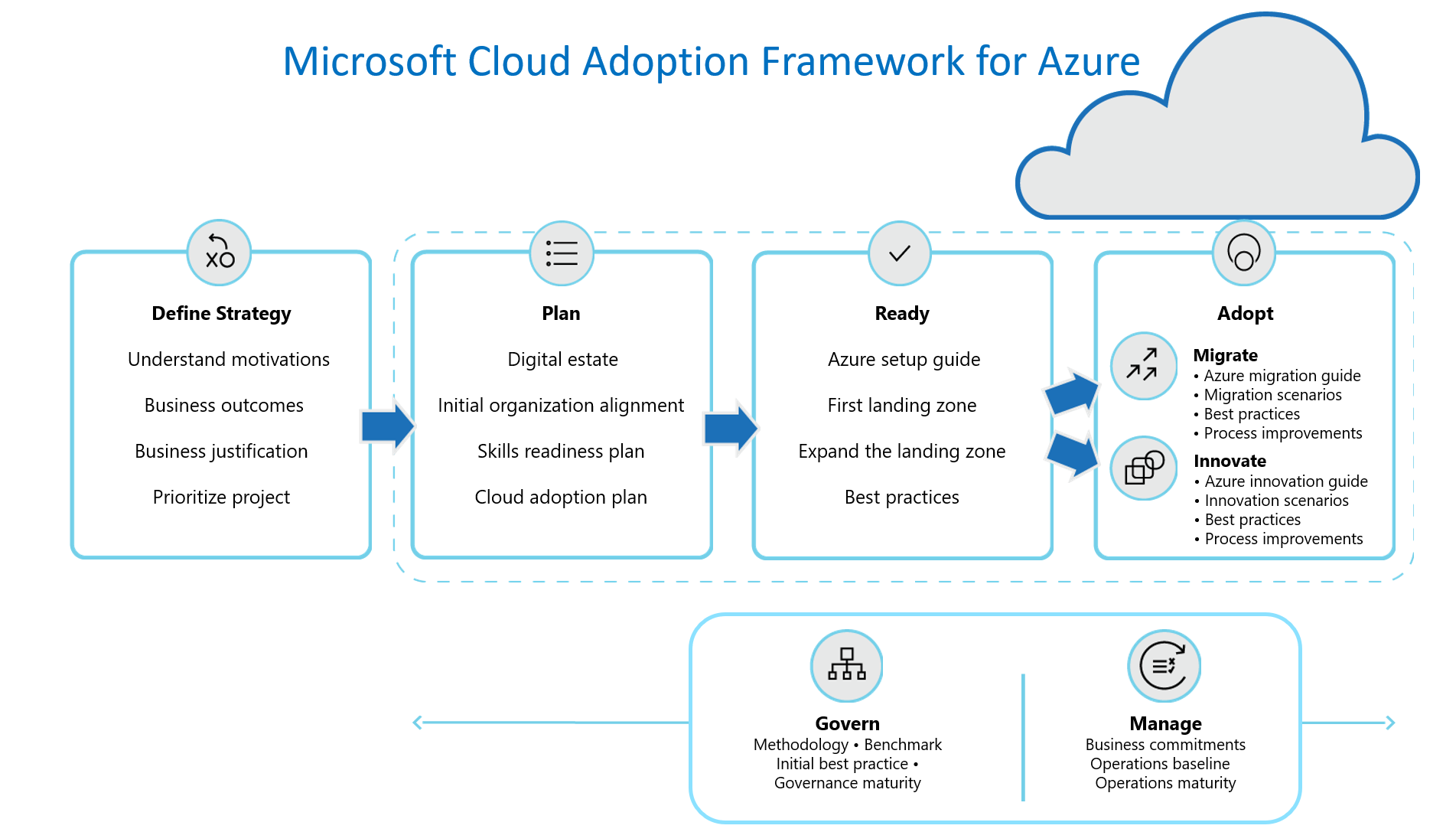
(Image Source: Microsoft)
Let’s look at each section more closely.
Strategy
The Strategy phase focuses on understanding why the organization is pursuing cloud adoption and what business outcomes it hopes to achieve.
This stage involves:
Defining business drivers
Identifying cloud motivations
Establishing goals and KPIs
Building executive alignment
Creating initial cloud vision documents
Microsoft provides templates to help organizations create cloud strategy and planning documents that identify:
Stakeholders
Business goals
Digital estate inventory
Transformation priorities
The Strategy phase establishes the foundation for every later cloud decision.
Plan
Once the strategy is defined, organizations move into planning.
The Plan phase focuses on converting cloud goals into actionable execution plans.
This includes:
Inventorying existing assets
Evaluating workloads
Prioritizing migrations
Determining hosting strategies
Building migration roadmaps
CAF also emphasizes organizational readiness during this stage.
Cloud adoption often requires new technical skills, operational processes, and governance models. Organizations may identify gaps in:
Azure expertise
Cloud security
DevOps automation
Governance management
Operational monitoring
At Emergent Software, we often help organizations evaluate these readiness gaps and recommend training or implementation strategies to support successful cloud adoption.
Ready
The Ready phase focuses heavily on Azure Landing Zones and foundational environment preparation.
Azure Landing Zones provide the architectural foundation for cloud environments, including:
Resource organization
Identity management
Networking architecture
Security standards
Governance structures
Naming conventions
The goal is to create a scalable, maintainable Azure environment before large-scale deployments begin.
Without strong foundational architecture, cloud environments can become difficult to manage as they grow.
The Ready phase helps organizations establish standards early instead of retroactively correcting architectural inconsistencies later.
Adopt
The Adopt phase focuses on actually moving workloads into Azure.
Microsoft identifies four common adoption approaches:
Migrate — Move workloads into Azure with minimal application changes.
Modernize — Improve applications using cloud-native Azure capabilities.
Innovate — Build new cloud-native solutions designed specifically for Azure.
Relocate — Move Azure workloads between regions for compliance, latency, or resiliency.
Different applications may require different adoption approaches.
For example:
Some legacy systems may simply be migrated quickly.
Others may require full application modernization.
New customer-facing systems may justify entirely cloud-native architectures.
CAF helps organizations determine the right approach for each workload instead of forcing a single migration strategy across every system.
Govern
The Govern phase focuses on cloud governance, compliance, and operational guardrails.
Cloud governance defines:
Roles and responsibilities
Security policies
Cost controls
Compliance requirements
Resource standards
Operational boundaries
One major focus area within CAF governance is Azure Policy.
Azure Policy helps organizations enforce standards automatically across their Azure environment.
For example, Azure Policy can:
Restrict unsupported resource deployments
Enforce tagging requirements
Apply security configurations
Prevent policy violations
Governance is not a one-time exercise. CAF treats governance as an evolving operational process that grows alongside the organization’s cloud footprint.
Manage
The Manage phase focuses on ongoing cloud operations and maintenance.
This includes:
Monitoring
Alerting
Backup management
Automation
Cost optimization
Business continuity
Several Azure services play important roles during this stage:
Azure Monitor — Collects telemetry, performance metrics, and operational insights.
Azure Automation — Automates operational tasks and workflows.
Azure Backup — Protects workloads and recovery points.
Azure Site Recovery — Supports disaster recovery and business continuity strategies.
Operational maturity becomes increasingly important as cloud environments scale over time.
The Manage phase helps organizations move beyond deployment and focus on long-term operational success.
How Do I Use the Microsoft Cloud Adoption Framework?
If you are new to CAF, Microsoft provides a helpful Getting Started page that walks organizations through early planning decisions.
However, applying CAF effectively still requires significant planning, technical expertise, and operational coordination.
Even with Microsoft’s guidance, cloud modernization projects can become complex quickly, especially when organizations are balancing:
Legacy systems
Security requirements
Compliance obligations
Budget constraints
Operational continuity
That is one reason many organizations choose to work with experienced Azure consulting partners who already have practical experience applying the Cloud Adoption Framework across real-world cloud projects.
At Emergent Software, we have extensive experience helping organizations modernize and migrate workloads into Azure following CAF principles and Microsoft best practices.
Microsoft also recognized our expertise by awarding us the advanced specialization for Modernization of Web Applications with Microsoft Azure.
Get in touch to tell us about your cloud project.
How Emergent Software Can Help
We help organizations plan, modernize, secure, and manage Azure cloud environments using Microsoft’s Cloud Adoption Framework and Azure best practices. Our team supports cloud migrations, landing zone architecture, governance implementation, DevOps automation, managed services, and application modernization initiatives. If this sounds familiar, we can help.
Final Thoughts
Successful cloud adoption requires more than simply moving workloads into Azure. Organizations need strategy, governance, operational planning, and scalable architecture to realize the full value of cloud technologies.
Microsoft’s Cloud Adoption Framework provides an excellent roadmap for navigating those challenges. By following CAF principles, organizations can reduce risk, improve operational consistency, and build cloud environments designed for long-term growth.
If you're ready to build or modernize your Azure cloud environment, Emergent Software is here to help. Reach out — we'd love to learn more about your goals.
Frequently Asked Questions
What is the Microsoft Cloud Adoption Framework?
The Microsoft Cloud Adoption Framework, often called CAF, is a collection of guidance, tools, templates, and best practices designed to help organizations adopt Microsoft Azure strategically. It covers areas like cloud strategy, migration planning, governance, operations, security, and modernization. CAF is intended to support organizations throughout the full lifecycle of cloud adoption. Microsoft continuously updates the framework as Azure services evolve. It is widely used by businesses and Azure consulting partners.
What are the stages of the Cloud Adoption Framework?
The six major stages of the Cloud Adoption Framework are Strategy, Plan, Ready, Adopt, Govern, and Manage. Strategy and Plan focus on business goals and migration planning. Ready prepares the Azure environment through landing zones and architecture standards. Adopt covers migration and modernization activities. Govern and Manage focus on ongoing operational governance, monitoring, security, and cloud management. Together, these stages create a structured roadmap for cloud adoption.
What is an Azure Landing Zone?
An Azure Landing Zone is a foundational cloud environment designed to support scalable, secure, and governed Azure deployments. Landing zones include networking, identity management, resource organization, governance policies, and operational standards. They help organizations avoid inconsistent cloud architecture as environments grow over time. Landing zones are a major focus within the “Ready” phase of CAF. Proper landing zone design improves long-term maintainability and operational efficiency.
Why is cloud governance important?
Cloud governance helps organizations maintain control, security, compliance, and operational consistency across cloud environments. Without governance, cloud environments can become fragmented, insecure, and difficult to manage. Governance includes policies around security, resource management, cost controls, access management, and compliance standards. Azure Policy plays a major role in enforcing governance rules automatically. Effective governance becomes increasingly important as organizations scale cloud adoption.
How does CAF help with Azure migrations?
CAF helps organizations plan and execute Azure migrations more strategically by providing structured guidance and best practices. The framework helps businesses evaluate workloads, prioritize migrations, modernize applications, and establish governance standards before deployment begins. It also helps organizations align cloud adoption with business goals instead of approaching migration purely as an infrastructure project. CAF reduces risk by promoting consistent architecture and operational planning. Many Azure consulting partners use CAF as the foundation for migration methodologies.
Should businesses work with an Azure consulting partner?
Many organizations benefit from working with an experienced Azure consulting partner because cloud adoption can become complex quickly. A strong partner helps apply CAF principles effectively while reducing operational risk and accelerating implementation. Azure consultants bring expertise in governance, security, landing zones, migration planning, DevOps automation, and cloud modernization. They also help organizations avoid common mistakes that can create long-term operational problems. For many businesses, this guidance significantly improves cloud adoption outcomes.
Author



Let’s Start Building Together
Whether you're modernizing legacy apps, strengthening your cloud security, or planning your next big initiative, Emergent Software is here to help.