

In This Blog
TL;DR
Successful custom software development requires flexibility, collaboration, and ongoing feedback.
Emergent Software uses an Agile-inspired approach focused on delivering business value early and often.
Projects are broken into manageable features that are prioritized, defined, built, tested, demonstrated, and refined.
Iterative development reduces project risk and allows businesses to adapt as requirements evolve.
The goal is to deliver usable software faster while maintaining alignment with business objectives.
We've worked hard to establish a custom software development process that reflects how modern software projects actually succeed.
While every software development company claims to follow Agile practices, we believe the real differentiator is how those practices are applied. Every business, every project, and every team is different. A successful software development process should reflect those differences.
At Emergent Software, our approach focuses on delivering business value quickly while maintaining the flexibility needed to adapt as projects evolve.
Let's take a closer look at how we approach custom software development and why we believe this process leads to better outcomes for our clients.
Our Goals for Every Software Project
Every custom software project begins with a clear set of goals.
Regardless of the industry, technology, or business challenge involved, we focus on four key objectives:
Build, test, and demonstrate features that deliver the greatest business value first
Reduce risk throughout development and deployment
Develop a deep understanding of your business and operational needs
Create a foundation that supports long-term success and growth
You may recognize some Agile project management concepts within this approach.
Agile itself is not unique to Emergent Software. Many successful software development firms use Agile methodologies to manage projects and deliver solutions.
Where we believe we stand apart is our ability to adapt Agile concepts to fit each client's unique circumstances.
Custom software is, by definition, custom. We don't believe our clients should be forced into a rigid process that doesn't align with how their business operates.
Custom Software Development Is Not Easy
Before discussing our process in detail, it's important to acknowledge a reality that many organizations discover during their first software project:
Custom software development is complex.
That doesn't mean your goals can't be achieved. It simply means that software projects often reveal new information as development progresses.
Most organizations don't know every requirement, workflow, edge case, or integration challenge before development begins.
That's perfectly normal.
Rather than trying to define every detail upfront, we prefer to break projects into manageable pieces and solve them iteratively.
Think of the process like building a brick wall.
Each feature represents a brick. Before moving on to the next brick, we make sure the current one is stable, functional, and aligned with your expectations.
One key difference between software development and bricklaying is that you get the opportunity to inspect each feature as it's completed.
This ongoing feedback loop helps prevent costly surprises and reduces the risk of discovering problems late in the project.
Our Custom Software Development Process
When a client comes to us with an idea, many assume development starts immediately.
In reality, successful projects begin with discovery, planning, and alignment.
Before writing code, we spend time understanding:
Your business goals
Your users
Your processes
Your technical environment
Your priorities
This planning phase helps us understand what success looks like and identify the most valuable path forward.
The development process itself is built around rapid, transparent, iterative execution.
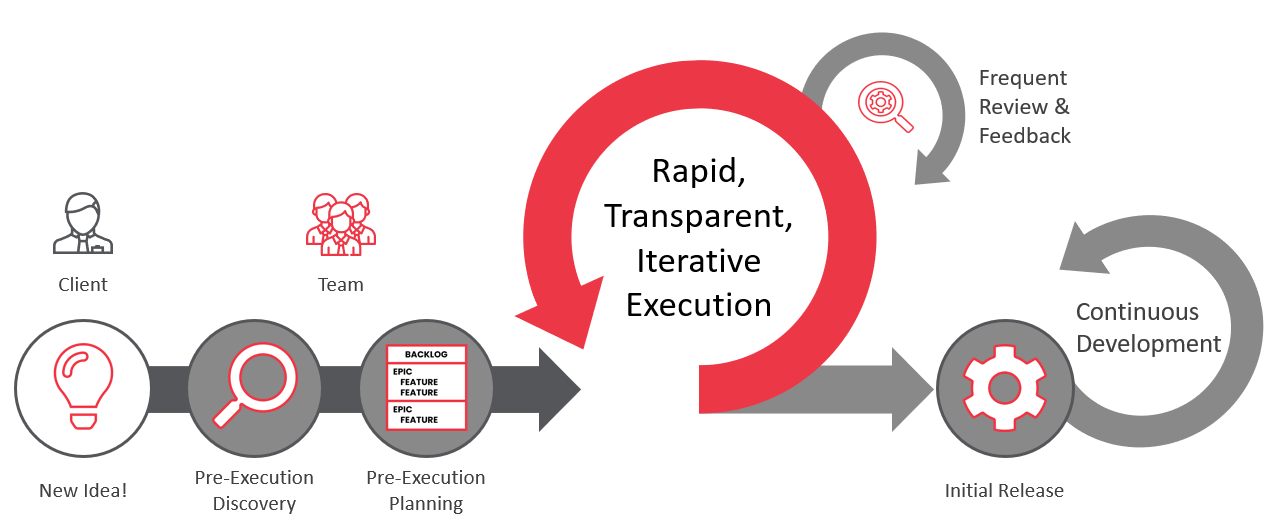
While every project is different, this framework provides structure while allowing flexibility.
Our process is intentionally collaborative. We view development as an ongoing dialogue between our team and yours.
That collaboration helps ensure the final solution aligns closely with your business needs.
The Four Steps We Repeat Throughout Development
Once development begins, four key activities occur repeatedly throughout the project lifecycle.
Prioritize
Define
Build, Test, Show
Feedback & Accept
These steps are repeated continuously as new features move through development.
Prioritize
We work together to identify which features will provide the greatest value and should be developed first.
Define
Requirements are clarified, refined, and documented to ensure everyone understands what is being built.
Build, Test, Show
Our team develops the feature, tests it thoroughly, and demonstrates the results to stakeholders.
Feedback & Accept
Your feedback is incorporated before moving on to the next feature.
This cycle continues throughout the project, allowing for ongoing refinement and continuous value delivery.
Why We Use an Agile Development Approach
We believe Agile development offers significant advantages over more traditional project methodologies.
Many traditional approaches attempt to define and build an entire solution before users see meaningful results.
This often increases project risk and delays the realization of business value.
Our approach focuses on delivering complete, functional pieces of the solution as quickly as possible.
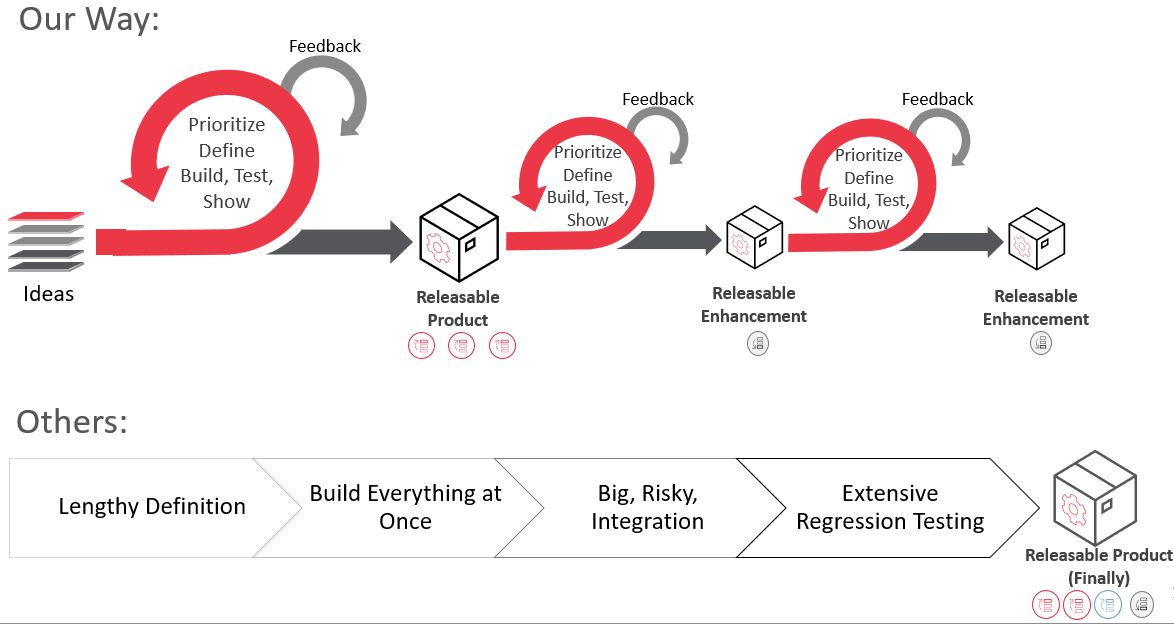
By delivering smaller increments of value, we can:
Reduce project risk
Improve stakeholder visibility
Validate assumptions earlier
Respond to changing requirements
Accelerate time to value
Agile development also helps ensure that critical business functionality is delivered before lower-priority enhancements.
This prioritization allows organizations to begin realizing benefits earlier in the project lifecycle.
How Agile Development Reduces Risk and Increases Value
One of the biggest benefits of iterative software development is flexibility.
As features are completed and feedback is gathered, organizations gain the ability to make informed decisions about future priorities.
Rather than waiting until the end of the project to see results, stakeholders can continuously evaluate progress and determine when the software provides enough value to release.
This creates several advantages:
Earlier return on investment
Greater responsiveness to market opportunities
Reduced likelihood of building unnecessary features
Better alignment between software and business needs
By focusing first on the most critical functionality, organizations can launch valuable solutions sooner while continuing to improve them over time.
This flexibility allows businesses to react to changing market conditions and customer needs without waiting for every planned feature to be completed.
That's one of the primary reasons Agile development has become the preferred approach for many successful software organizations.
If you're interested in learning more about Agile delivery, check out part two of this series, which takes a deeper dive into what happens once development begins.
And if you'd like to discuss your own project, we're only a phone call or email away.
How Emergent Software Can Help
Emergent Software helps organizations solve complex business challenges through custom software development, cloud solutions, application modernization, data engineering, and managed services. Our team combines technical expertise with a collaborative, business-focused approach that helps clients deliver software faster, reduce risk, and create long-term business value. If this sounds familiar, we can help.
Final Thoughts
Successful software development is about more than writing code.
It's about understanding business goals, reducing risk, gathering feedback, and delivering value continuously throughout the project lifecycle.
Our iterative approach allows organizations to stay involved, adapt to changing priorities, and see meaningful progress throughout development.
If you're considering a custom software project and want a partner that values transparency, flexibility, and business outcomes, reach out to our team. We'd love to learn more about your goals.
Frequently Asked Questions
What is custom software development?
Custom software development is the process of designing, building, testing, and maintaining software specifically created for the needs of a particular organization. Unlike off-the-shelf software, custom solutions are tailored to unique business processes, requirements, and goals. Custom applications can improve efficiency, automate workflows, and create competitive advantages. Organizations often choose custom software when commercial products do not fully meet their needs. The development process typically involves close collaboration between business stakeholders and technical teams.
Why is Agile development popular for custom software projects?
Agile development allows teams to build software incrementally while continuously gathering feedback from stakeholders. This approach reduces risk because problems can be identified and corrected early in the project. Agile also helps organizations adapt to changing requirements and business priorities. Rather than waiting until the end of the project to see results, stakeholders receive ongoing visibility into progress. This often leads to better outcomes and higher satisfaction.
How long does a custom software project take?
The timeline for a custom software project varies depending on scope, complexity, integrations, and business requirements. Some projects may take only a few months, while larger enterprise applications can take a year or longer. Agile methodologies allow organizations to begin realizing value before every feature is complete. Prioritizing high-value functionality often enables earlier releases. The best timeline depends on the specific goals of the project.
Why is iterative development important?
Iterative development allows teams to build, test, review, and improve software in smaller increments. This approach helps reduce risk by validating assumptions throughout the project. Stakeholders can provide feedback as features are completed rather than waiting until the end. Problems are identified earlier, and changes can be made more efficiently. Iterative development often leads to higher-quality outcomes and better alignment with business needs.
What happens before software development starts?
Before development begins, teams typically spend time understanding business objectives, user needs, technical requirements, and project priorities. This discovery and planning process helps establish a clear direction for the project. It also identifies potential risks, dependencies, and opportunities for improvement. While not every detail must be defined upfront, having a strong foundation improves project success. Effective planning helps ensure development efforts focus on delivering meaningful business value.
Why work with Emergent Software?
Emergent Software combines technical expertise with a business-focused approach to software development. We help organizations align technology investments with strategic goals while maintaining flexibility throughout the development process. Our team emphasizes transparency, collaboration, and iterative delivery to reduce risk and accelerate value realization. We tailor our process to fit each client's unique needs rather than forcing a one-size-fits-all methodology. Our goal is to build software that creates measurable business outcomes.
Author



Let’s Start Building Together
Whether you're modernizing legacy apps, strengthening your cloud security, or planning your next big initiative, Emergent Software is here to help.